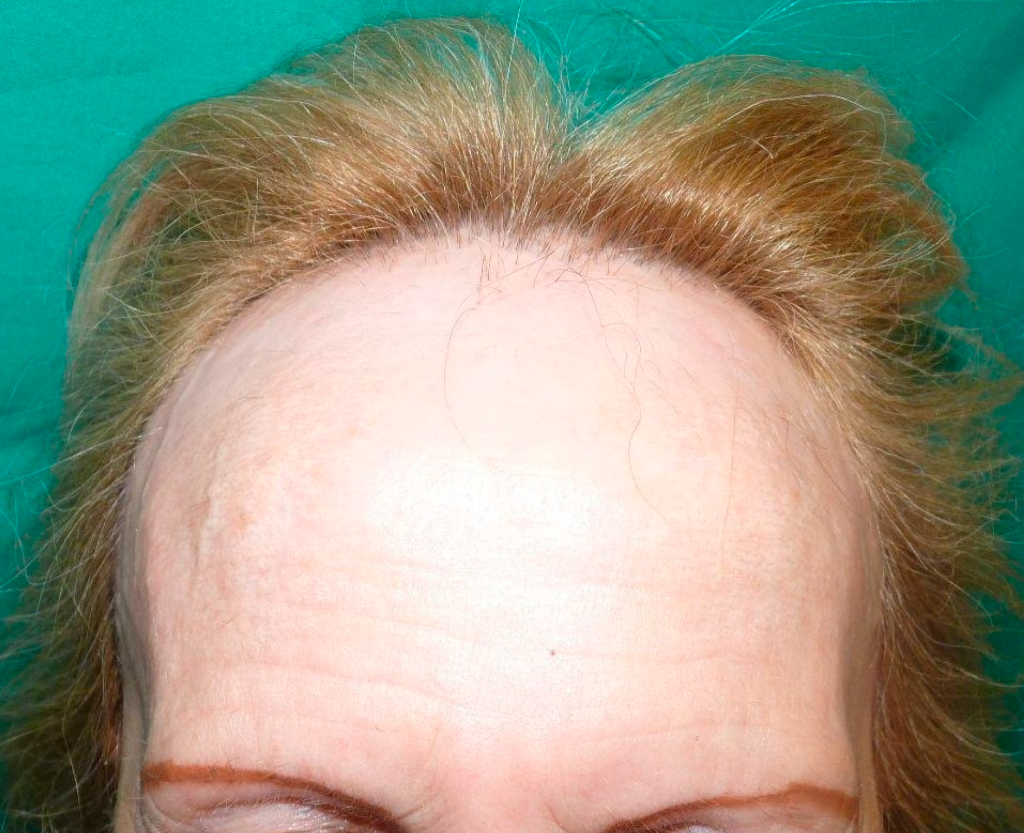
Frontal fibrosing alopecia (FFA) is a condition which causes permanent hair loss on the frontal and temporal parts of the scalp. Hair loss can also involve the eyebrows and, in men, the beard. Frontal fibrosing alopecia occurs most commonly in postmenopausal women although it can also affect younger women and men.
What causes frontal fibrosing alopecia?
The cause of FFA is unknown. It is likely that both hormonal changes and the immune
system play a role in its development. The fact that it is mostly seen in postmenopausal
women strongly supports the hypothesis that hormones are likely to play a part.
What are the symptoms and signs of frontal fibrosing alopecia?
Frontal fibrosing alopecia is often asymptomatic but, in some cases, may be associated with itching, pain or burning.
Frontal fibrosing alopecia causes progressive recession of the frontal hairline. There may be some redness and scaling around the hair follicle opening. Destruction of hair follicles in FFA results in irreversible hair loss. Loss of eyebrow hair is common.
How is frontal fibrosing alopecia diagnosed?
Frontal fibrosing alopecia can often be recognised by its characteristic appearance and distribution. However, if the diagnosis is uncertain, a biopsy may be performed.
How is frontal fibrosing alopecia treated?
The treatment of FFA may include:
Topical, intralesional or oral corticosteroids
Topical calcineurin inhibitors
Oral anti-androgen therapy e.g., finasteride and dutasteride
Doxycycline
Hydrodroxychloroquine
Systemic immunosuppressants e.g., ciclosporin and methotrexate
Janus kinase inhibitors e.g., tofacitinib and baricitinib