
Hair Transplantation
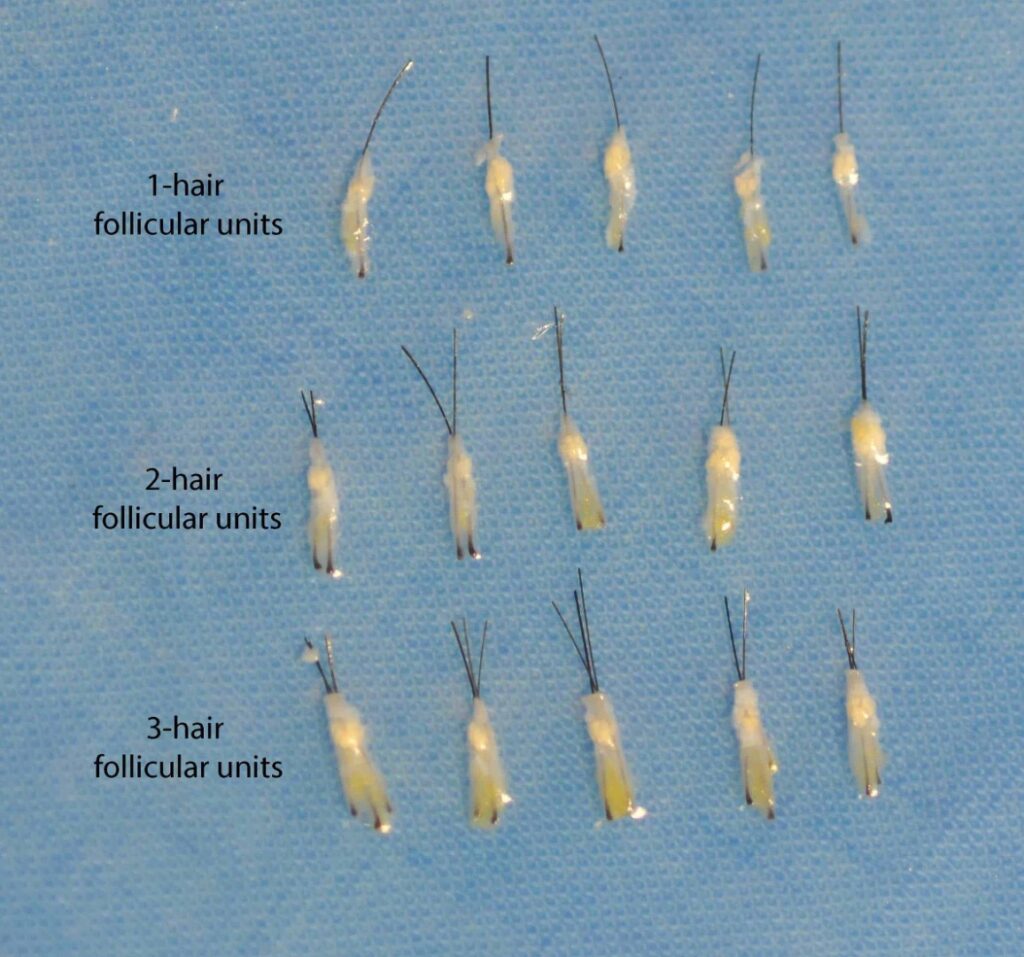
Hair transplantation is a minimally invasive surgical procedure which is performed under local anaesthesia. The technique of hair transplantation is predicated on the principle of “donor dominance”. The hair on the back and sides of the scalp is not androgen-sensitive and is consequently resistant to balding. “Donor dominance” refers to the concept that hair transplanted from the donor area (back and sides of the head) to the androgen-sensitive recipient area (mid-frontal scalp and vertex) retains its native characteristics which preclude hair loss.
In modern hair transplantation, hair follicles are implanted individually. This technique of transplanting so-called “micrografts” can yield natural-looking results and produce a high degree of patient satisfaction.
Male pattern hair loss and female pattern hair loss are the most common indications for hair transplantation. However, other forms of hair loss can also benefit from hair transplantation, including:
- Certain types of non-scarring alopecia e.g., traction alopecia and congenital triangular alopecia
- Selected cases of primary cicatricial alopecia e.g., frontal fibrosing alopecia
- Secondary scarring alopecia e.g., surgical scars and burns
Follicular Unit Transplantation
Follicular unit transplantation (FUT), also known as the strip method, involves the removal a strip of skin from the back and sides of the head. The defect is then closed with sutures. Individual follicular units comprising 1-4 hairs are separated and subsequently implanted into the recipient area. The FUT technique generally allows the surgeon to harvest a large number of hair follicles for transplantation, and is therefore the preferred method in men with extensive hair loss. However, the laxity of the patient’s scalp determines the width of the strip, and consequently the number of grafts, that can be harvested.
It is noteworthy that although a linear scar is inevitable with the FUT method, it can be covered within existing hair. Furthermore, the “trichophytic closure” method is used to minimize the appearance of the scar.
An important consideration post-operatively is to minimize wound tension in order to improve the appearance of the scar. Activities which increase tension on the donor area such as bending or heavy lifting should be avoided for the first two months.
Follicular Unit Excision
Follicular unit excision (FUE) is a technique which involves the extraction of individual follicular units from the back and sides of the head, thereby providing a larger surface area from which to harvest grafts. FUE is technically more difficult than the traditional FUT method as it requires an understanding of skin and hair characteristics e.g., hair type and curl, and direction and angle of hair growth. Management of the entire donor area is essential to ensure that extractions do not result in a visible reduction in density of the residual hair. FUE is considered less invasive than FUT. It is ideal for smaller procedures requiring fewer grafts e.g., minimal hairline recession or eyebrow reconstruction.
Prior to the procedure, the donor area is shaved to allow the surgeon to assess the direction and angle of hair growth. With the FUE method, follicular units comprising 1-4 hairs are individually extracted. A surgical punch is used to make a circular incision around the follicular unit, separating it from the surrounding tissue and allowing its extraction from the skin. Dr Bhoyrul generally uses an 0.8 mm punch although this may vary depending on the hair type. Due to the small size of the punch, the extraction site is virtually imperceptible to the naked eye. Consequently, patients can cut their hair short following an FUE procedure.
Body Hair Transplantation
Body hair transplantation (BHT) allows the surgeon to restore hair density when donor limitations preclude the extraction of a sufficient quantity of grafts from the scalp. This may be due to the need for a large number of grafts beyond what the scalp can provide, or previous hair transplants which have extracted most of the available scalp donor hair.
Body hair transplantation relies on the same method of extraction as scalp FUE. In BHT, grafts are harvested from the body instead of the scalp.
An important consideration is that body hair transplanted to the scalp will retain its dominant characteristics including colour, length, thickness and texture. However, it has been suggested that the recipient skin influences the growth rate and cycle duration of the transplanted body hair to mimic the growth characteristics of the recipient site hair (“recipient influence”). In selected cases, BHT can provide an excellent alternative to scalp hair transplantation.
Hair transplantation is a minimally invasive surgical procedure which is performed under local anaesthesia. The technique of hair transplantation is predicated on the principle of “donor dominance”. The hair on the back and sides of the scalp is not androgen-sensitive and is consequently resistant to balding. “Donor dominance” refers to the concept that hair transplanted from the donor area (back and sides of the head) to the androgen-sensitive recipient area (mid-frontal scalp and vertex) retains its native characteristics which preclude it from hair loss.
In modern hair transplantation, hair follicles are implanted individually. This technique of transplanting so-called “micrografts” can yield natural-looking results and produce a high degree of patient satisfaction.
Male pattern hair loss and female pattern hair loss are the most common indications for hair transplantation. However, other forms of hair loss can also benefit from hair transplantation, including:
- Certain types of non-scarring alopecia e.g., traction alopecia and congenital triangular alopecia
- Selected cases of primary cicatricial alopecia e.g., frontal fibrosing alopecia
- Secondary scarring alopecia e.g., surgical scars and burns