Dissecting Cellulitis of the Scalp

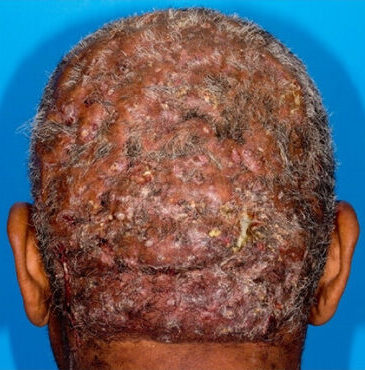
Dissecting cellulitis of the scalp (also known as perifolliculitis capitis abscedens et suffodiens) is a rare inflammatory scalp condition. The prolonged inflammation dissecting cellulitis of the scalp causes destruction of the hair follicle and replacement with scarring, resulting in permanent hair loss.

Dissecting cellulitis of the scalp usually affects darker-skinned adult men, especially those of Afro-Caribbean origin, but if can affect patients of any sex, age or race. It can be associated with other conditions such as acne conglobata and hidradenitis suppurativa.

What causes dissecting cellulitis of the scalp?

The cause of dissecting cellulitis of the scalp is unknown, although it is likely due to blocked and ruptured hair follicles, resulting in significant inflammation and secondary bacterial infection.

What are the symptoms and signs of dissecting cellulitis of the scalp?

Dissecting cellulitis of the scalp causes painful spots and lumps which may ooze pus. In severe cases, there may be large abscesses. It may affect any part of the scalp.

Dissecting cellulitis of the scalp initially presents with inflamed nodules and pus-filled spots which may coalesce to form abscesses resulting in hair loss and scarring. Destruction of hair follicles in dissecting cellulitis of the scalp results in irreversible hair loss.

How is dissecting cellulitis of the scalp diagnosed?

Dissecting cellulitis of the scalp can often be recognised by its characteristic appearance and distribution. However, if the diagnosis is uncertain, a biopsy may be performed.

How is dissecting cellulitis of the scalp treated?

The treatment of dissecting cellulitis of the scalp may include:

  • Intralesional corticosteroids
  • Topical antibiotics e.g., clindamycin
  • Oral antibiotics e.g., doxycycline
  • Dapsone
  • Isotretinoin
  • Biologics e.g., adalimumab
  • Surgery

Dissecting Cellulitis of the Scalp
OUR MISSION

Male-pattern baldness tends
to develop slowly

Hair loss, or alopecia, isn't just a problem for adults. Hair loss in children is responsible for an estimated 3% of pediatric office visits in the U.S. Whether your child has thinning hair or distinct bald spots, the loss of hair can be frightening. The good news is that, with a proper diagnosis, most cases of hair loss can be treated successfully.

Hair Loss in Children

Hair loss, or alopecia, isn't just a problem for adults. Hair loss in children is responsible for an estimated 3% of pediatric office visits in the U.S. Whether your child has thinning hair or distinct bald spots, the loss of hair can be frightening. The good news is that, with a proper diagnosis, most cases of hair loss can be treated successfully. Medical Causes of Hair Loss in Children For the majority of children 26 months or older suffering hair loss, one of the following conditions is the cause. Your child's pediatrician or a pediatric dermatologist should be able to diagnose these conditions and prescribe the appropriate treatment. Tinea capitis. Tinea capitis, commonly known as ringworm of the scalp, is a fungal infection often seen in children. It can show up in a number of ways, but often as scaly patches of hair loss on the head. The patches are usually round or oval. The hairs may be broken off at the surface of the skin and look like black dots on the scalp. If your child's doctor suspects tinea capitis, a microscopic examination can confirm the diagnosis. Treatment usually involves an oral antifungal, such as griseofulvin taken by mouth for eight weeks. Your child should also use an antifungal shampoo such as selenium sulfide or ketoconazole to decrease shedding of the fungus.

For younger children, treatment consists primarily of strong corticosteroid ointments or creams applied to the bald areas. Teenagers, who may be sufficiently motivated to have their hair return, may tolerate steroid injections into the scalp. Minoxidil (Rogaine) is often used in additional to topical steroid treatment. Anthralin applied to the skin for a short time and then washed off may also be used. Hair growth may come back in 8-12 weeks.