
Lichen Planopilaris
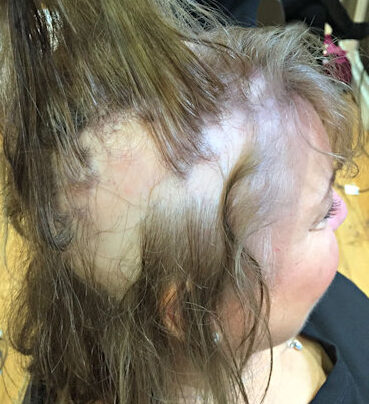
Lichen planopilaris (LPP) is a rare type of scarring hair loss which results from inflammation targeting the hair follicle. The inflammation in LPP causes destruction of the hair follicle and replacement with scarring, leading to irreversible hair loss. Lichen planopilaris is considered a variant of lichen planus, a chronic inflammatory condition which can also affect the skin, nails and mucous membranes.
What causes lichen planopilaris?
The cause of LPP is unknown but it has been suggested that it is an autoimmune disease.
What are the symptoms and signs of lichen planopilaris?
Lichen planopilaris may be associated with symptoms such as itching, pain or burning.
It commonly affects the scalp vertex, although any part of the scalp may be involved. Patients may report increased hair shedding. The inflammation in LPP causes redness and scaling of the skin around the hair follicle opening. Destruction of hair follicles results in smooth and shiny patches devoid of hair.
How is lichen planopilaris diagnosed?
Lichen planopilaris can often be recognised by its characteristic appearance and distribution.
However, if the diagnosis is uncertain, a biopsy may be performed.
How is lichen planopilaris treated?
The treatment of LPP may include:
- Topical, intralesional or oral corticosteroids
- Topical calcineurin inhibitors
- Doxycycline
- Hydrodroxychloroquine
- Systemic immunosuppressants e.g., ciclosporin and methotrexate
- Janus kinase inhibitors e.g., tofacitinib and baricitinib