

Central Centrifugal Cicatricial Alopecia
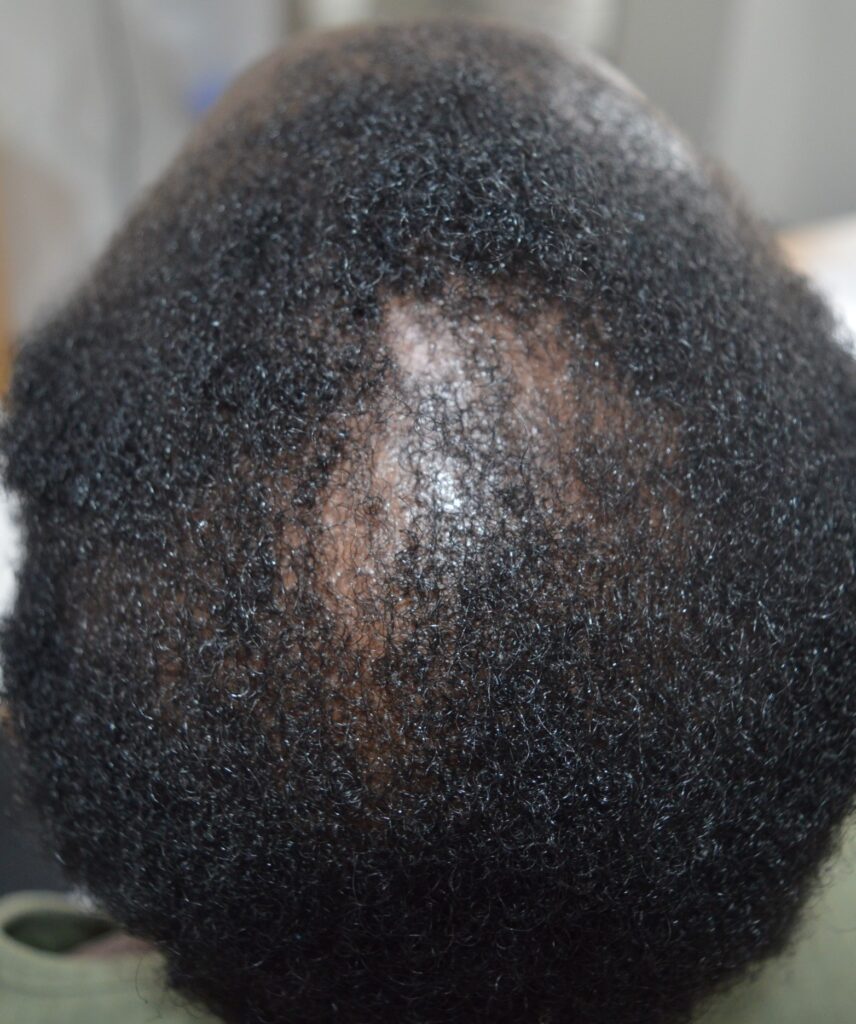
Central centrifugal cicatricial alopecia (CCCA) is a type of scarring hair loss which usually starts on the scalp vertex and spreads outwards. It is the most common form of scarring alopecia seen in women of African descent, with a typical age of onset of 30-40 years.

What causes central centrifugal cicatricial alopecia?

The cause of CCCA is not fully understood but may be related to the following factors:

  • A mutation in the PADI3 gene has been found in some patients with CCCA
  • Traumatic hair care practices e.g., hair straightening using hot combs and chemical relaxers, tight hairstyles, braids and weaves are thought to be risk factors but the link is controversial
  • Increased tendency to develop fibrosis (scarring) e.g., keloid scars and uterine fibroids
  • Possible association with type 2 diabetes mellitus

What are the symptoms and signs of central centrifugal cicatricial alopecia?

Often there are no symptoms. However, some patients may experience itching, burning, tingling, or tenderness. Hair breakage may precede scarring hair loss. Central centrifugal cicatricial alopecia typically begins on the scalp vertex and spreads outwards (described as a centrifugal pattern). The affected areas may have a shiny appearance.

How is central centrifugal cicatricial alopecia diagnosed?

Central centrifugal cicatricial alopecia can often be recognised by its characteristic appearance and distribution. However, if the diagnosis is uncertain, a biopsy may be performed.

How is central centrifugal cicatricial alopecia treated?

The treatment of CCCA may include:
  • Avoidance of traumatic hair grooming practices
  • Topical, intralesional or oral corticosteroids
  • Topical calcineurin inhibitors
  • Topical minoxidil
  • Low-dose oral minoxidil
  • Doxycycline
  • Antimalarial drugs e.g., hydroxychloroquine
  • Systemic immunosuppressants e.g., ciclosporin and methotrexate
  • Hair transplantation if condition has been stable for 1-2 years

Dissecting Cellulitis of the Scalp
OUR MISSION

Male-pattern baldness tends
to develop slowly

Hair loss, or alopecia, isn't just a problem for adults. Hair loss in children is responsible for an estimated 3% of pediatric office visits in the U.S. Whether your child has thinning hair or distinct bald spots, the loss of hair can be frightening. The good news is that, with a proper diagnosis, most cases of hair loss can be treated successfully.

Hair Loss in Children

Hair loss, or alopecia, isn't just a problem for adults. Hair loss in children is responsible for an estimated 3% of pediatric office visits in the U.S. Whether your child has thinning hair or distinct bald spots, the loss of hair can be frightening. The good news is that, with a proper diagnosis, most cases of hair loss can be treated successfully. Medical Causes of Hair Loss in Children For the majority of children 26 months or older suffering hair loss, one of the following conditions is the cause. Your child's pediatrician or a pediatric dermatologist should be able to diagnose these conditions and prescribe the appropriate treatment. Tinea capitis. Tinea capitis, commonly known as ringworm of the scalp, is a fungal infection often seen in children. It can show up in a number of ways, but often as scaly patches of hair loss on the head. The patches are usually round or oval. The hairs may be broken off at the surface of the skin and look like black dots on the scalp. If your child's doctor suspects tinea capitis, a microscopic examination can confirm the diagnosis. Treatment usually involves an oral antifungal, such as griseofulvin taken by mouth for eight weeks. Your child should also use an antifungal shampoo such as selenium sulfide or ketoconazole to decrease shedding of the fungus.

For younger children, treatment consists primarily of strong corticosteroid ointments or creams applied to the bald areas. Teenagers, who may be sufficiently motivated to have their hair return, may tolerate steroid injections into the scalp. Minoxidil (Rogaine) is often used in additional to topical steroid treatment. Anthralin applied to the skin for a short time and then washed off may also be used. Hair growth may come back in 8-12 weeks.