Dissecting Cellulitis of the Scalp
Dissecting cellulitis of the scalp (also known as perifolliculitis capitis abscedens et
suffodiens) is a rare inflammatory scalp condition. The prolonged inflammation dissecting
cellulitis of the scalp causes destruction of the hair follicle and replacement with scarring,
resulting in permanent hair loss.
Dissecting cellulitis of the scalp usually affects darker-skinned adult men, especially those of
Afro-Caribbean origin, but if can affect patients of any sex, age or race. It can be associated
with other conditions such as acne conglobata and hidradenitis suppurativa.
What causes dissecting cellulitis of the scalp?
The cause of dissecting cellulitis of the scalp is unknown, although it is likely due to blocked
and ruptured hair follicles, resulting in significant inflammation and secondary bacterial
infection.
What are the symptoms and signs of dissecting cellulitis of the scalp?
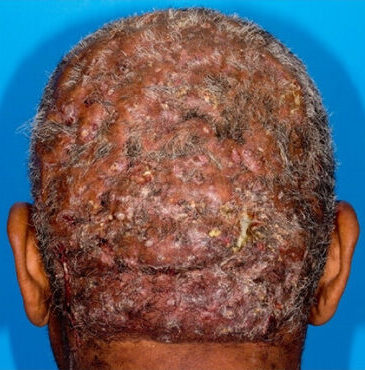
Dissecting cellulitis of the scalp causes painful spots and lumps which may ooze pus. In
severe cases, there may be large abscesses. It may affect any part of the scalp.
Dissecting cellulitis of the scalp initially presents with inflamed nodules and pus-filled spots
which may coalesce to form abscesses resulting in hair loss and scarring. Destruction of hair
follicles in dissecting cellulitis of the scalp results in irreversible hair loss.
How is dissecting cellulitis of the scalp diagnosed?
Dissecting cellulitis of the scalp can often be recognised by its characteristic appearance and
distribution. However, if the diagnosis is uncertain, a biopsy may be performed.
How is dissecting cellulitis of the scalp treated?
The treatment of dissecting cellulitis of the scalp may include:
- Intralesional corticosteroids
- Topical antibiotics e.g., clindamycin
- Oral antibiotics e.g., doxycycline
- Dapsone
- Isotretinoin
- Biologics e.g., adalimumab
- Surgery
Dissecting Cellulitis of the Scalp